Wednesday, November 20, 2013

Meeting Ryan McBride

Ryan is a developer who has been with many of the large game companies in the Greater Salt Lake area, mainly being EA, Disney and SmartBomb. He talked a lot about his experiences getting into these places and the hiring process. He started off with a small explanation of who he is and how he started. He began in the QA department of a video game development studio. Over time he learned to code and then slowly transitioned into a developer position at the company he was at.

Next he explained a few of the difference between working at a smaller scale company versus and large company. He recommended that we all start with smaller game companies for jobs. Not only are they easier to get into but they'll also be using your skills in many different aspects. This shuffling around will give you experience in multiple places in game development and maybe help you find you niche. Then once you have suitable connection it is significantly easier to migrate to a larger scale game company. Often times companies look at your completed projects and contacts before even looking at any sort of education you may have, if checking that at all even. Then out of all of the types of video games he said that mobile was the easiest to get into currently since that market is expanding more than most, then later you can consider transitioning into PC or a console based company.

So Ryan explained to us a few good ways to impress companies. The first way he said to impress them was to pick up an open-source API and build something cool with it. By doing that we'd be getting experience working with code that is not ours and showing that we can take something pre-made and develop something neat using it. The next thing was to improve your Server managing skills since many things are moving to Cloud-based, that way you can 'wow' the companies by being prepared.

Ryan discuss that in his personal opinion these were his priorities when deciding if he should hire someone:

  • People Skills and Communication come first because if you can't communicate effectively it will be hard to work with you.
  • He then checks how their brain works. If someone is of a similar mindset then they'll be more open to your ideas and easier to work with.
  • Finally he checks their experiences and education, more oriented towards their experiences. He explained that companies want to see that you can complete a project rather than leave many half-finished.
A few extra side notes he left us with were:
  • That readable code will always be superior to compact code. Just because your code has less lines in it doesn't make it any more coder-friendly. The few milliseconds you shave off with the compact code slows down the overall development time because other coders will have to decipher what's happening, rather than having the code explain itself.
  • And then he listed a few goo areas for developers to get jobs.
    • San Francisco
    • Seattle
    • Austin

Meeting Shane Smit

When Shane Smit came in to present to us he covered a few new topics as well as going into depth on a few previously introduced topics.
Firstly he discussed his experiences in industry. Most of the time people will get tossed around to various areas of the industry to help out in multiple parts of the game, especially in smaller companies or as indie developers. So one should always be prepared to learn new concepts and be willing to learn. The industry is also heavily driven by money. This should sound like common sense but people underestimate just how important it is that video games make a profit. Every time a company agrees to make a game they, usually, have to invest large sums of money. A quote from Shane touched on this topic: "Video games are a service." Now that means that we, as developers, must make sure our games fit as a service and give the users something they're looking for. That means we have to adapt to what is currently popular with our audiences.

Shane went on to discuss how we have to make a game successful based on popularity. As previously stated, we must adapt to the constant changes of the market to make sure our games are relevant to what the consumer wants. One way of doing this is by developing games after popular movies. The hard part about making movies into video games is that they both have to be released at the same time, to capitalize on the market's hype. If they aren't released at the same time the game might suffer because the movie will lose some of its hype and become less popular. So crunch time is very important for these types of games. If the game isn't released by its expected date then the company is already losing a large sum of money.

Finally he discussed how games have to come together as a whole. To make a game successful it must be solid and complete. Now that might sound like common sense too but there are many games that are 'complete' but not 'solid'. To have a solid game aspects of the game cannot be missing or lacking. If UI or sound is missing or terrible quality people won't play it because of the general unpleasantness of it. One big aspect of the game that draws people in is the menu. The menu has to be appealing and cool to make people want to play and proves that your game isn't just a crappy student project. So making the game is actually a very small part of the designing process, with a majority of it spent making tools and making those tools work with the game.

Saturday, November 2, 2013

Meeting Victor Chelaru

In our meeting with Victor he explained some of the process behind creating a game and the pipeline of people it goes through. He drew a diagram how a common pipeline would work: it starts at the developer who makes the concept for the game, then the developer passes it off to two teams; the artists and the programmers. The artists then draw up all the graphics that might be implemented in the game before passing those assets onto the programmers as well. The programmers then have to take all of this and make it into a workable game which is then sent off to marketing to promote. The problem with this way of doing this is that there has to be a constant dialog between the programmers and the artists / developer. And each dialog that has data loss, ergo some of the idea is lost from the developers original idea to what the programmer completes. Victor estimated that about 10% of the information was lost each step, so by the time it got to the programmers it could be as low as 50% of the original information that was intended to be passed along.

A fix for this, that Victor proceeded to speak about, was cutting out the middle man. Ergo he said that the developer should be as much of a programmer as possible, therefore negating the information loss. By doing this the game's core concepts are all there. As for the artists he explained how they should have an easy enough time implementing their assets into the game so they can see how it works and fix it as needed, thus removing the dialog between the programmer and the artist as well. Now this is the best case situation and it may be hard at times to even come close to achieving a pipeline such as this.

To finish he spoke about our goals and how we need to focus on what we truly need. As programmers & developers, we shouldn't try and expect what to do way ahead of time. If we try to predict everything we'll never actually get anywhere with coding it, we'll be stuck in the theory stage. Also the best feedback is from those who aren't developers or programmers, and who aren't afraid to hurt your feelings.

Tuesday, October 22, 2013

Meeting Aaron Walker


               Aaron works at Disney and when he came to present to us he brought a very professional manner to it. His presentation had a seriousness to it as he discussed what we’d be facing in our futures exactly. I enjoyed his presentation due to the fact that I learned what to expect.

                Firstly he explained that learning never stops; a coder must always be ready to expand his knowledge. In most of his experiences he coded in C++, which is the language we are currently studying most. He went on to explain how it is best for someone to find their ‘niche’ spot in coding, whether that is physics, UI development, etc, etc. By having a niche specialty companies and coworkers know exactly what you’re good at and they can rely on you in those aspects. One of his quotes, which I’ll share, also portrayed the importance of handling whatever task is given to you: “To be successful, work hard and do anything they bring to you.” If one is to follow this quote then to be successful one has to be an important asset to whichever company you may be working for; doing so will lead to you getting more responsibilities and trust from your company and people will come to you because you can get the job done.

                Further on in his presentation he explained how his company worked in their creation process. One thing that he made sure to drive home was that every game they created has a crunch time, or a Code Red as they called it. As a developer you must be able to motivate yourself through these times and get the job done; but maybe even more important than that is having something that in the end you’re proud of. If you’re not proud of what you’re doing then you’ll be less motivated to continue. So it is quite important to find that motivation to make something amazing. A good helpful tip he also gave us was to make release versions of our product to test how it runs without all of the debug code holding it together, that way we can foresee any problems that may be experienced in the user’s end result.

                Throughout all of his presentation I learned just how intense the coming jobs would be. I can’t just freely go into a job expecting it to be fun without any hard work. To truly succeed as a Video Game Developer I’ll have to work hard and motivate myself to make a product as great as possible.

Meeting Rich Reagan


           Throughout Rich’s presentation he was very well-spoken and was funny enough to keep the audience interested, not that we weren’t already interested to begin with. He went on to discuss how games are developing and how the video game market has to adapt to that changing market. If we can’t adapt to the market then our video games will go out of style, much like the cassette player did once MP3 players were produced. Due to smart phones more and more people, who aren’t avid gamers, are getting easy access to a variety of video games. This opens up the video game market to many casual gamers such as the older generations and those who are just barely coming into video games, so these games must be marketed to this new audience as well as interesting those already familiar with video games.

An interesting trend that Steve pointed out is that games are beginning to go ‘freemium’, which means that the game is released for free and either some content of the game requires money to buy or the game just repeatedly asks for appropriate donations for their effort. With the video game genre expanding to reach broader audiences the freemium style of producing games is becoming more prevalent. But by going with the freemium route those video games must be fun, or addicting enough, to make people willing to pay for that content. For example, the player could farm for hours to get a decent quality item or they could pay a small sum of real-world money to acquire an item of superior or unique quality. Doing this perfectly means that the player is willing to make that small micro-transaction because they believe that it is beneficial for them to do so. On the other hand competition drives freemium purchases. By having players compete amongst each other they’ll be much more open to giving money in order to gain an edge or some aesthetical value that the other players may not have.

Given all this information, I learned how we, as developers, must learn to view the changing tides of consumer and make fun games that reach out to those audiences while still being profitable to our company.

Tuesday, September 17, 2013

AI Decision Trees

To begin implementing AI into any game, one must first design how the machine is going to think and react. The easiest way to do so is through a decision tree. A decision tree is like a branching river; the flow goes in one direction but the branching paths might lead the flow in drastically separate areas.
The basis for designing a decision tree requires that your AI has states to keep in mind, such as moving to a designated area and then moving back. As a start, here is the image of my AI example with all of the players in a resting state.

At this point their current state was one of doing nothing. They just sat there until I gave the program the right to start. But once they began, the Decision Making started.

---

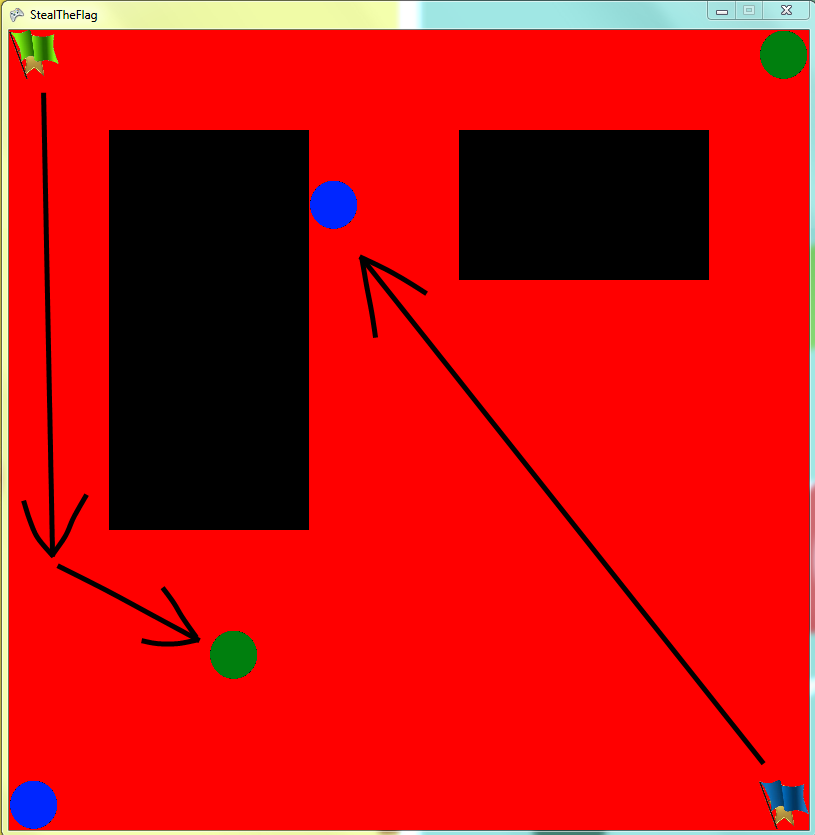
The players at the top-right and the bottom-left of the screen are classified as defenders, whose job is to only stop players when they've picked up one of the flags, so their decision tree is telling them to sit there and wait until someone takes the flag. The other two players begin moving towards the opposing flag immediately since their decision tree dictates them to do so.


---

But why does their decision tree tell them to do so? Let's take a closer look at the decision tree involved with their movements.

Firstly there exists an overarching Decision Node. Inside this node is the "question" that it must ask, in this case that question is "Does the player currently have the flag?". Every update of the program, this Decision Node checks its question and then decides how the player will react based on the result it has found. Once an answer has been found, the Decision Node will direct towards one of the State Nodes that come along with it. These State Nodes exist simply to change the state of the player into whatever the State Node's are programmed to contain. In our example this means that if the player currently has the flag, the Decision Node will direct him to the Return to Base Node and the player will understand that he need to return to base.
Now Decision Nodes don't always need to come to an abrupt end with State Nodes. Decision Nodes could always lead into other Decision Nodes and deepen the logic further. This manner of layered Decision Nodes is what gives alot of the game's AI the ability to think, or to at least pretend that it is thinking.

---

So now that we understand why the player is moving the way he is, we can easily understand how the defenders work.

The defenders are looking for the signal when an opposing player picks up their flag. As soon as they do the Decision Node gives the defenders a new order to seek out the enemy and reclaim their flag. Their Decision Tree is very similar to the attackers, except that their only states are "defending" and "seeking".

Since the Decision Tree is nearly constantly updating, the player's will always be complying to one of their two states. Therefore when one of the defenders hits the player and returns the flag (as seen in the example with the top two players) that player will then automatically seek out the flag once again. This makes it so there is never an interruption in logic.

Tuesday, August 20, 2013

A* Pathing

A* pathing is a simple way of calculating how an AI can get from Point A to Point B in the most efficient way. The code does this by calculating which node has the least cost expended when it travels there. In the following list I'll be going step by step through what the code does when it calculates through a simple path:

  • So first, we designate the starting node and the ending node. In the example picture we use A & F.
  • To begin we start with the starting node. That node is then placed on the open list.
    • Put simply there are two lists we use in A* Pathing to keep track of what we've stepped over and what we are considering.
      • The Open List is the list that all of our currently examined node sit in.
      • The Closed List is a list of all of the nodes we've stepped over or 'completed'.
  • Then we calculate the connections to our starting node. For our example A only has one connection, B. but if it had more than one connection we'd calculate all of those as well. By calculating I mean that it finds the Heuristic and Cost to move to B, as well as the Estimated Total Cost it will get to the ending node.
    • The Heuristic is a value for how far away the current node is from the ending node. There can be many different ways of calculating this value, but the simplest is to use a bird's path or straight line from the current node to the ending node.
    • The Cost So Far is how far the node has moved from the starting node along the path. Each path has a 'distance' and as we move through the path we keep track of the cumulative amount of that 'distance' for this variable. In the example, A has a Cost So Far of Zero because it hasn't moved at all yet.
    • The Estimated Total Cost is, simply put, the sum of the Heuristic and the Cost So Far.
  • Once we have calculated all of the connections to A, it is put on the closed list.
  • Then we figure out which of the nodes on the open list has the least Estimated Total Cost. Once we find that we continue with the steps for the node A.
  • For the sake of my fingers and your eyes, we'll skip over the process for the B node since its exactly the same as A's.
  • Moving onto C, we can notice that there are now two nodes it connects to. So we calculate both of those just like before and then more C onto the closed list.
  • Because D has a lower Estimated Total Cost than E, our program should continue on with D and put E to the side on the open list for now.
  • Then once D is done calculating and is moved onto the closed list, F is chosen next because of its still lower Estimated Total Cost than E.
  • Then there's some simple logic for figuring out the end condition. The simplest way to do so would be to just have the program consider when the end node is selected but there are other end conditions where coders choose to have it so "when every node is on the closed list", that way every possibility is checked.


Now some of you might ask "But Daniel, what if E's connection to F is shorter than D's?" and the answer is simple. The way A* Pathing should work with its calculations means that if D's connection was larger, for example 7 instead of 3.5, then that would make F's Estimated Total Cost larger than E's on the open list and then we'd check E. This of course would make us reevaluate F's values and since there's no other open nodes to check we simply take F, which is the ending node and causes the ending condition.